

Everybody knows what gas costs. The price is on a sign forty feet tall at every corner. Regular went from just under $3 before the Iran war to well over $4.
The yearly tally for how much this costs the average consumer is broadcast constantly by politicians and the news media. There is another number that is not discussed: the amount people pay in credit card interest. We pay it every month, just like the phone bill.
Well, we don’t expect the banks to lend us money for nothing. This piece is not about whether banks have a right to charge interest. It is about excessive interest and what it costs the nearly half of American households that carry card debt to get by.
Today the average card rate is about 21%, and many cards charge 25% to 30%.
Anything above 10% puts us into the realm of excessive interest, which is called usury and is condemned by all the major religions.
Many of those old prohibitions targeted loans to people in desperate circumstances: money for food, shelter, medical care. The moral line was clear: you don’t profit from your neighbor’s desperation. Charging the vulnerable more because you can was seen as tearing at the fabric of society. Today’s cards add a twist: teaser rates and generous credit limits entice people into purchases they can’t afford, by design, as my earlier pieces cover. Allowing lenders to charge more than 10% and trap people in debt seems immoral to me. Better to make people in a desperate situation find another way, and not let them buy things they cannot afford, than to leave them in a virtual debtors’ prison.
Why 10%? It is the cap now on the table: Sanders and Hawley introduced a bill for it in 2025, and Trump renewed his call for it in January. It is also where the banks can still make money. Researchers at Vanderbilt ran the numbers on the banks’ own data, counting the cost of money, cards that never get paid back, servicing, fraud and rewards. At 10%, after trimming rewards and marketing, cards would still be profitable for every group of borrowers with a credit score above 600. So in this piece, “excessive” means everything above 10%.
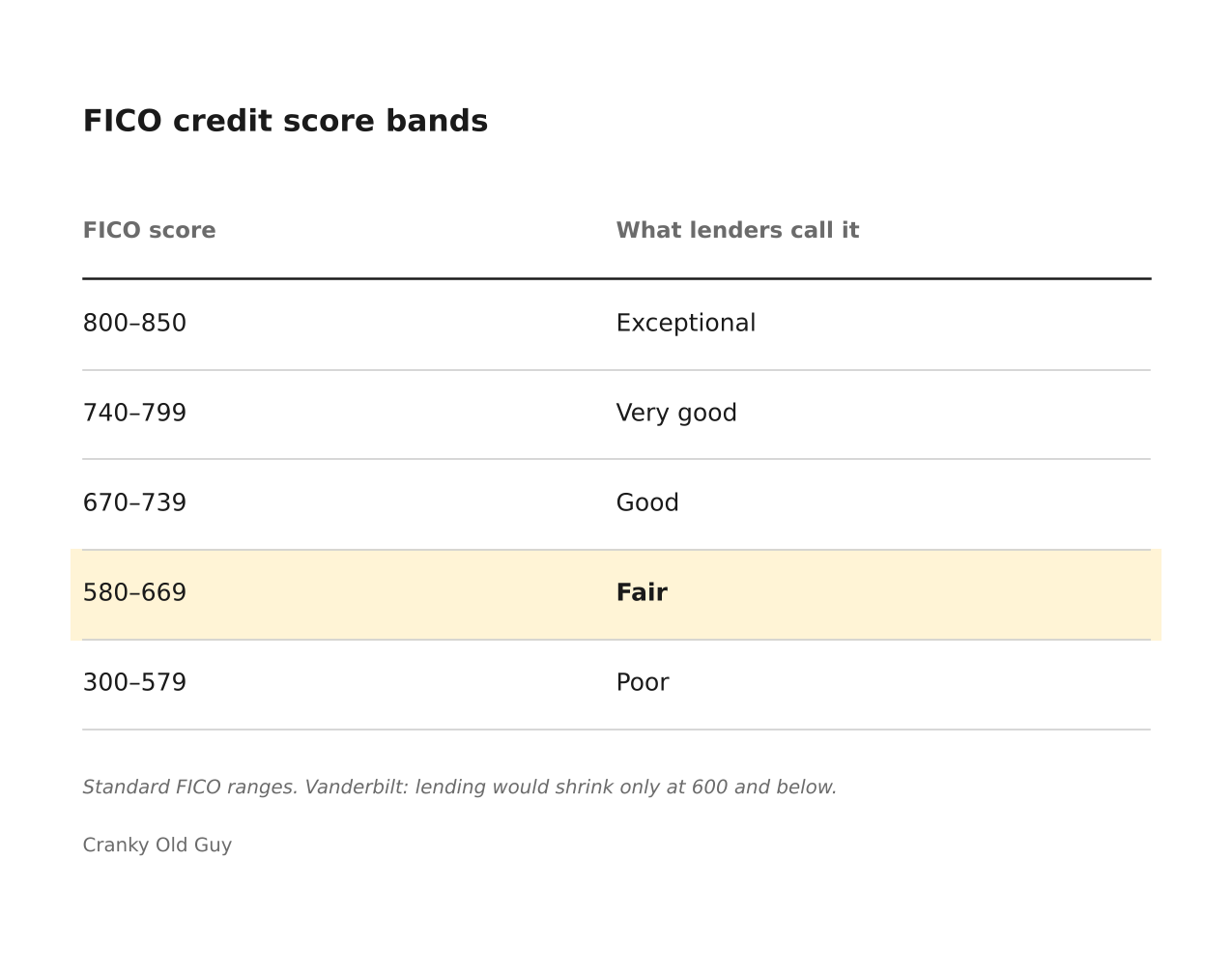
A 600 score sits in the lower part of “fair.” Only borrowers at 600 and below would likely see less credit under a 10% cap.
We don’t have to imagine a capped card market. Federal credit unions are capped by law, at 18% for now, and their basic cards averaged about 12.6% at the end of 2025, against about 15.3% for the same kind of card at banks. What bank customers actually pay is higher still: over 22% on accounts charged interest.
My earlier pieces explain how we got these high interest rates, if you are interested to know.
If Democrats Cared About Affordability, They Would Be Pushing for 10% Credit Card Caps
Show Me the Corruption: Name the Crime, Tell Me How You Know
Two bills
Americans paid $160 billion in credit card interest in 2024, by the CFPB’s count, and one industry estimate puts 2025 at $181 billion. Not everyone pays it. The Fed’s latest survey of family finances, published in October, found that 44.7% of families carry card debt, about 60 million households. Spread over them, that is about $2,650 to $3,000 a year each.
In that survey, families with card debt owed about $8,000 on average. Total revolving debt reached $1.37 trillion in September.
Pay only the minimum on that $8,000 at today’s 21%, using a common formula of 1% of the balance plus interest with a $25 floor, and it takes about 23 years and costs about $13,000 in interest, far more than the debt itself. At 10%, the interest would be about $6,000.
The average card rate is around 21%. A little over half of that interest is the part above 10%. Vanderbilt researchers put the savings from a 10% cap at about $100 billion a year. That is about $1,650 a year for each household that carries card debt.
Now the gas. Brown University’s tracker found the war cost consumers $73 billion extra on gasoline alone by mid-October, about $540 per household. At that pace, a full year would come to about $118 billion, or $880 per household. Nearly every household drives, so nearly every household pays it.
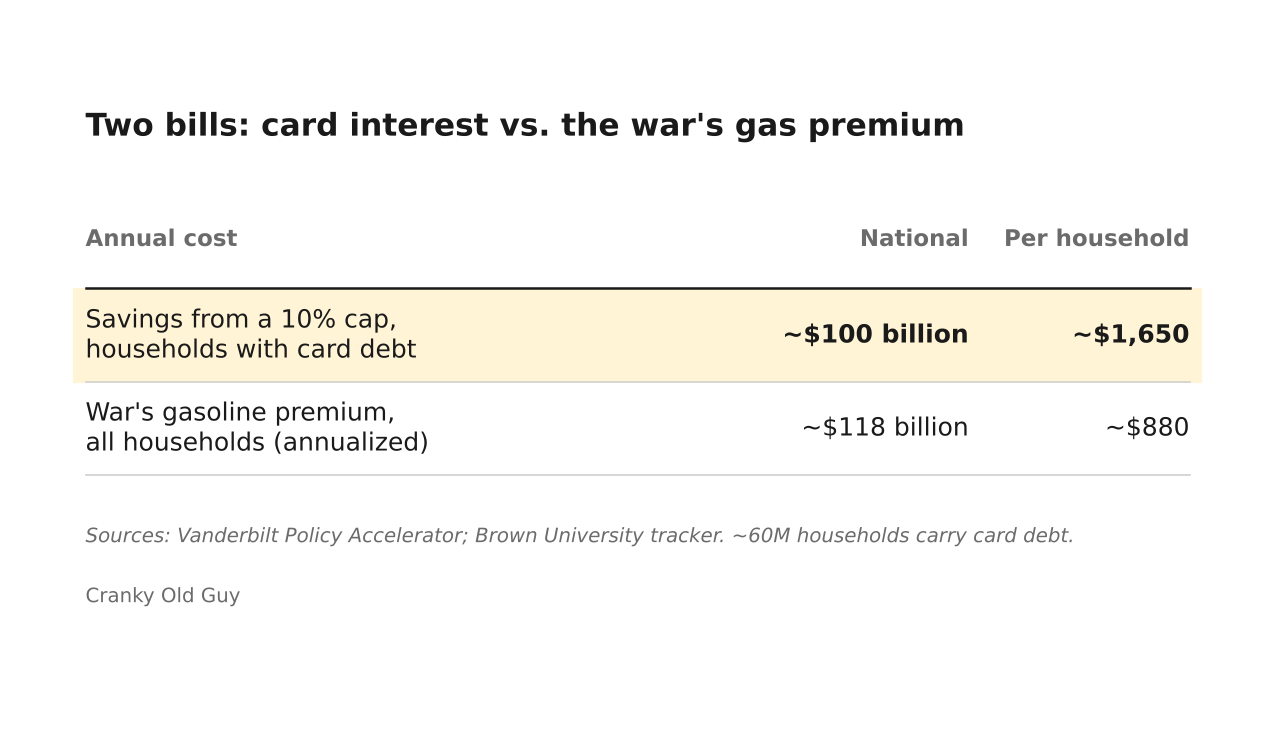
For the families who pay it, the card interest above 10% alone is almost twice the gas premium. One bill became a national crisis. The other has been around for years and comes due every year, war or no war.
Trump renewed his call for a one-year 10% cap in January. Even Speaker Mike Johnson, normally Trump’s yes-man, brushed it off: the idea was “probably not thought through,” he said, and reporters shouldn’t get “too spun up” about it.
Sanders and Hawley have a bill for 10% credit card rates.
A generation of it
One year is bad enough. Now add up a generation: the quarter-century since 2000. Here is my estimate, built from Federal Reserve data on card balances and card rates, with market returns from NYU’s Aswath Damodaran. Per-household figures divide by the roughly 60 million households that carry card debt today.
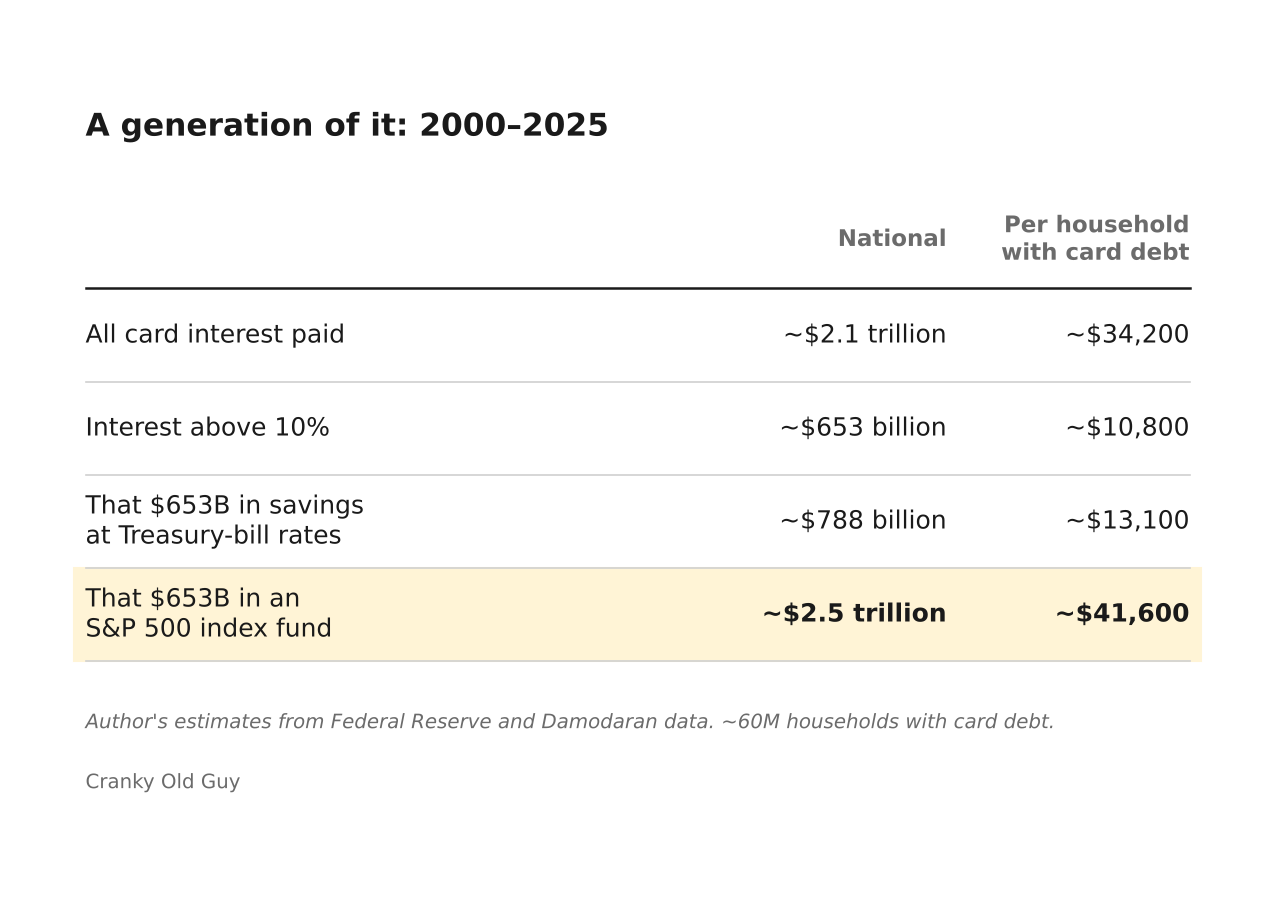
If the interest above 10% had gone into an index fund instead of to the card banks, it would come to the equivalent of about $41,600 for every household that carries card debt today. And it is speeding up: nearly two-thirds of it, about $426 billion, came in the last ten years.
Pick 10 years or 40 and the point holds; only the size of the number changes. These are a hobbyist journalist’s estimates. Exact figures are a job for the Congressional Budget Office and congressional staff, though I don’t see them doing this. It’s their job, not mine. A Congress that is supposed to be serving the people should not need me to bring this to its attention.
The senator from MBNA
Trump loves to blame any problem in the economy on the Biden administration. Here is something he missed, and it goes back a lot further than four years. This one even has a Hunter Biden subplot.
After the Supreme Court’s 1978 Marquette decision, which my earlier pieces explain, Delaware dropped its rate limits in 1981 and became the capital of the card industry. Chase Manhattan and J.P. Morgan opened card units in Wilmington almost immediately. By around 2000 the banks employed nearly 34,000 people and were the state’s largest employer. Delaware’s senator from 1973 to 2009 was Joe Biden.
The record:
He was one of the strongest Democratic backers of the 2005 bankruptcy bill, which made card debt harder to escape. A law professor told NPR he was critical to its passage. He voted for the 2000 version too.
In 2005 he was one of five Democrats who voted against making card companies tell customers what paying only the minimum costs.
MBNA, the Delaware card giant, was his largest contributor over two decades. It hired Hunter Biden out of law school and later paid him more than $400,000 in consulting fees from 2001 to 2005.
In a February 2005 Senate hearing, Biden told Elizabeth Warren that bankruptcy wasn’t the real issue: “Maybe we should talk about usury rates, then.” He was right. The bill passed with nothing on rates.
While he was vice president, the 2010 Dodd-Frank law created a new consumer bureau and barred it from capping interest rates.
As president, his consumer bureau went after late fees, not the rate, and even that never took effect. Neither administration has actually capped the rate, which is where the money is.
To be fair, Biden was not alone. When Sanders offered a 15% cap in 2009, it got 33 votes. Card banks have had friends in both parties for decades.
What the averages hide
Gas hits everyone who drives. Card interest falls on the families with the least room. Since 2023, average card balances rose 37% for people finding it difficult to get by, and 1% for people living comfortably. More than a third of adults wouldn’t cover a $400 emergency with cash or its equivalent, by the Fed’s count. About the same share carry a card balance. For those families, the card is the emergency fund, and it charges 21%. For the households that carry card debt, the interest above 10% alone is about $1,650 a year against $880 for gas, nearly twice as much.
The gas premium fades when the war ends. The card premium has run for a generation and has no end date.
Gas has a sign forty feet tall. Card interest is a line on page two of a monthly statement. That may be the whole difference.