

A note on the math: this is a hobby, not a research desk, and it is written against the clock. The IPO is weeks away, so this analysis has a short shelf life. I built these numbers with Claude as the lead on the work, and ChatGPT, Gemini, Grok and Mistral checking it. I have a lot of experience working with Claude and I’m confident in how this was done, but I have not personally checked every calculation, so please read the caveats. If Jamie Dimon wants to put his analysts on it, they’re welcome to. The formulas are below, and the calculator lets you check them yourself and change any assumption you disagree with.
In April I asked whether $380 billion was a sane price for Anthropic. (What Is Anthropic Worth?) My answer was yes, if you could live with the assumptions.
On October 26, Anthropic filed its S-1. The listing is expected before Thanksgiving on Nasdaq under the ticker ANT. The talk is a valuation of $1.5 to $2 trillion.
The price went up four to five times in six months. So it is time to ask the question again.
Not whether it is risky. Of course it is risky. Every nascent industry is. The question is whether it makes sense at all at these prices.
I’ll answer it two ways, with the same assumptions.
The first is the market’s way. Value the company ten years from now the way investors value a mature company today, at a multiple of its earnings. Then discount that back to today.
The second is the owner’s way, a discounted cash flow, essentially how Warren Buffett values a business. Never sell. Collect what the company pays out once it stops growing, and ask whether those payouts justify the price.
Both assume Anthropic pays you nothing for the first ten years, because every dollar goes back into growth.
Same Math, New Price
Here is essentially the April approach, with every assumption in one place. Change any of them and the answer changes. The calculator lets you.
White-collar workforce cost: about $60 trillion a year worldwide, fully loaded.
Share of that work AI replaces: 80%. That saves businesses $48 trillion a year.
Share of the savings businesses pay for AI: 50%. They switch only if they keep the other half. That makes a $24 trillion a year market.
Market growth: 3% a year, about what the world economy grows. In ten years the market is about $32 trillion.
Earnings: 25% of revenue.
Value: 13.6 times earnings, the AT&T multiple I used in April.
Anthropic’s share: one third.
New shares: 2% a year. Anthropic will sell stock to raise money and pay employees in stock, so each share you buy owns a smaller slice over time. After ten years, your slice is about 82% of what you bought.
Governance discount: 10%, a judgment call; there is no objectively correct number. Public shareholders can’t choose the board or force payouts, so a share is worth less than an AT&T share with the same earnings.
Time to get there: ten years. Nobody is earning anything like that today.
Return you demand: 10 to 15 percent a year. That is the rate used to discount future value back to today.
At 25% of revenue, the whole market earns $6 trillion a year. A company earning that today, at 13.6 times earnings, would be worth $82 trillion.
Anthropic will not own the whole market. Give it one third, and it is worth about $27 trillion, 14 to 18 times the IPO price.
But nobody is earning anything like that today. The model assumes the market gets there in ten years. By then it has grown 3% a year, so a one-third share is worth about $37 trillion. A dollar ten years from now is worth less than a dollar today. Discount that $37 trillion back ten years at 10 to 15 percent a year, shrink it to the 82% slice IPO buyers will still own, take 10% off for governance, and it is worth about $6.7 to $10.4 trillion today. That is still 3 to 7 times the IPO price.
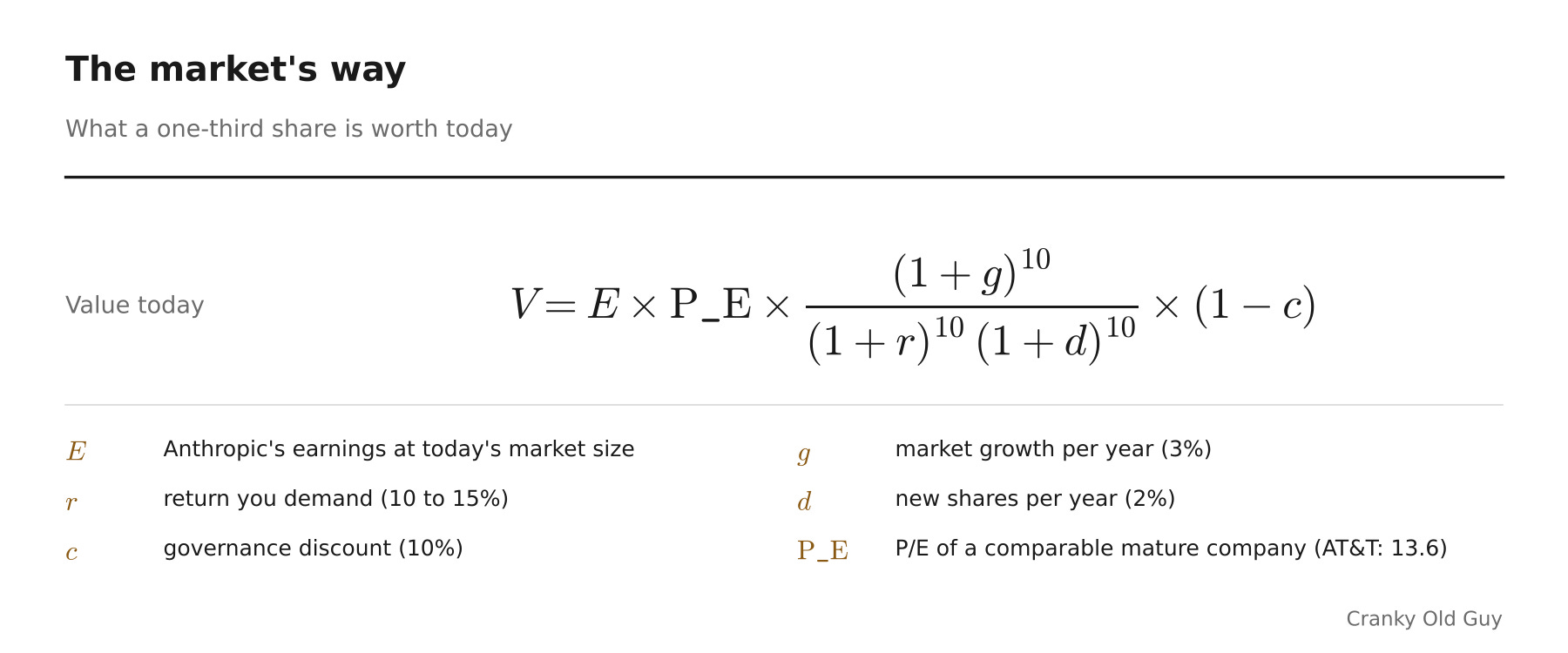
The price went up four- to fivefold. The math still says cheap.
How Much Does It Have to Earn?
Now the owner’s way. This is a discounted cash flow, which is essentially how Warren Buffett values a business: add up what it will pay its owners over the years, discounted back to today. Never sell, live on the payouts, and work backwards from the price.
The formula, for a company that pays out all its earnings once it stops growing:
What the payouts are worth in year ten: yearly earnings ÷ your return. That is 10 times earnings at a 10 percent return, about 8 times at 12, under 7 at 15. Stricter than AT&T’s 13.6.
What that is worth today: divide by (1 + your return)^10, then by (1 + new shares)^10 for the slice you still own, and take off the governance discount
Run it backwards to find what Anthropic must earn, and what share of the market that takes:
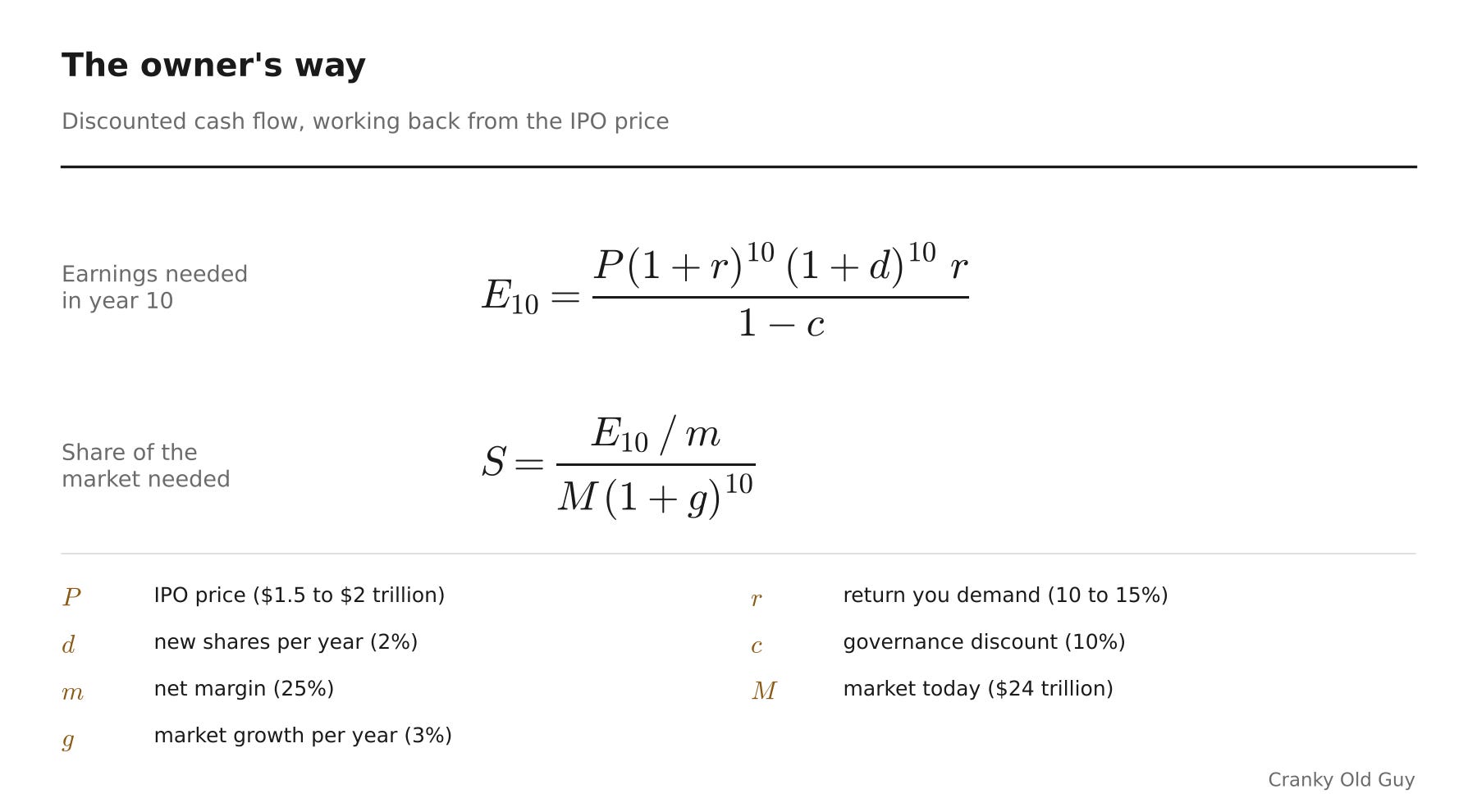
At a $2 trillion price and a 12 percent return: 2 × 3.11 × 1.22 × 0.12 ÷ 0.9 = about $1.0 trillion a year. Divide by 25% for revenue, $4.0 trillion, and by the $32 trillion market in year ten for the share, 12.5%. The table runs the same formula for each case.
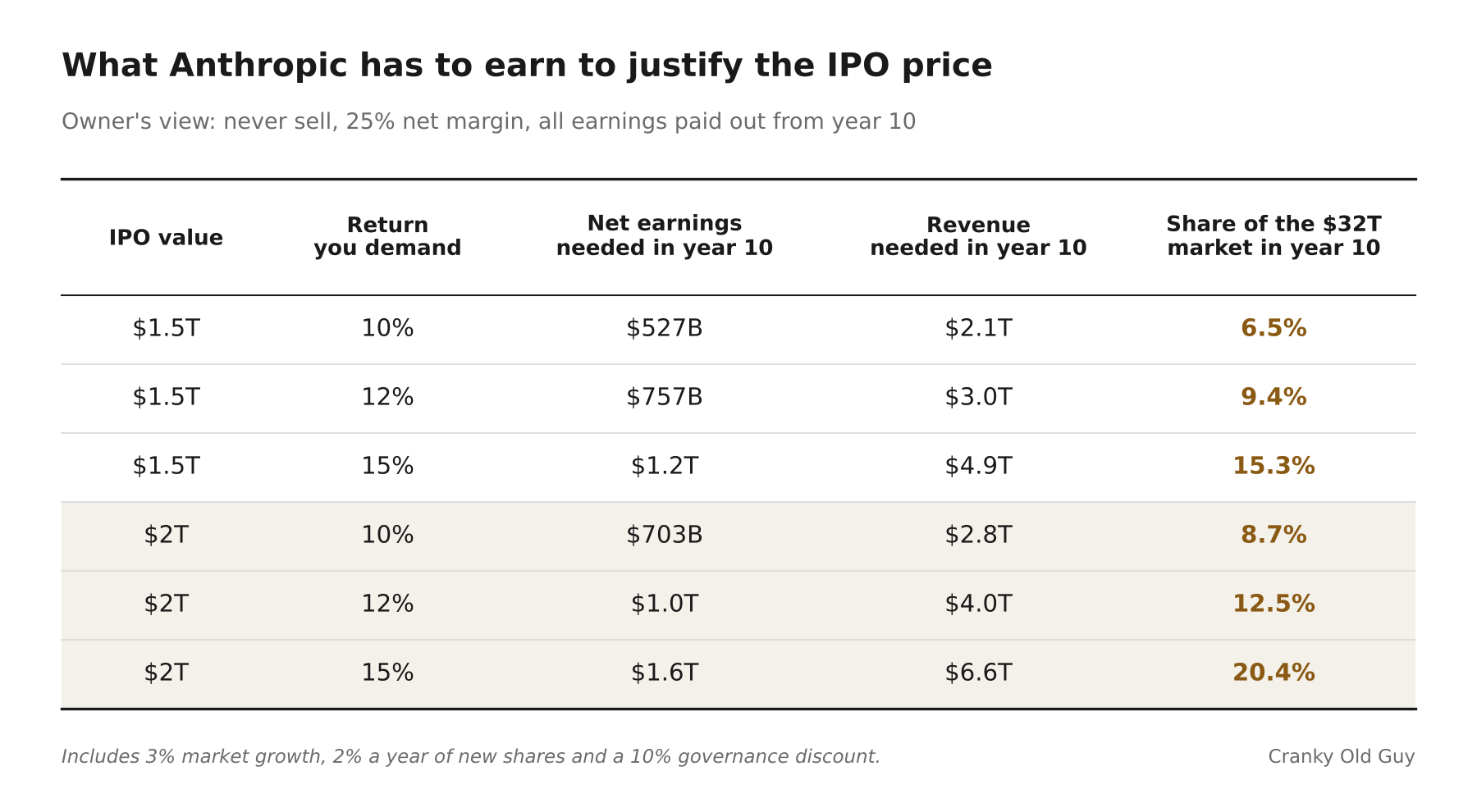
These figures include 2% a year of new shares and the 10% governance discount. Without both, each required share would be about a quarter lower.
The formulas here are simple. Tweak the numbers yourself in this calculator: plug in your own market size, margin, or return.
The good news: Anthropic does not need to dominate. At a 10 or 12 percent return it needs roughly 7 to 13 percent of the market. Demand 15 percent and it needs 15 to 20 percent.
The sobering part: that slice is $2.1 to $6.6 trillion a year in revenue. No company on earth sells that much today. From roughly $67 billion a year at its third-quarter pace, it means growing 41 to 58 percent a year for a decade.
What if it does reach a third of the market? Then the owner who never sells earns about 18 percent a year at a $2 trillion price, and about 20 percent at $1.5 trillion. At these prices you are not betting that Anthropic wins everything. You are betting it wins a meaningful slice of an enormous market.
The governance discount is there for a reason: you can’t make Anthropic pay you anything. The founders will hold 50.1% of the votes, a trust picks most of the board, and as a public benefit corporation it may weigh goals besides shareholder returns. What it pays out, and when, is its call, not yours.
What the Filing Tells Us
In April I worked from leaks and press reports. Now the numbers are in a filing with the SEC.
Revenue keeps climbing. $16.3 billion in the first half of 2026. Anthropic told investors Q3 was $16.8 billion, profitable on an adjusted basis. Quarter-over-quarter growth has eased from doubling to 46%. I never assumed it would keep compounding. I valued it as a business that stops growing once it matures.
The headline loss is mostly accounting. The headline is an $80.7 billion net loss for the half. About $72 billion of that is a non-cash charge on convertible notes. The reported operating loss was just $693 million on $16.3 billion of revenue. A year earlier it lost $2.1 billion on $1.2 billion.
The customers are concentrated. Its top five customers brought in about a quarter of revenue in the first nine months of 2026, though no single one topped 10%. Nearly half of revenue comes in through the Amazon, Google and Microsoft cloud marketplaces.
The compute bill is enormous. The filing lists about $417 billion in minimum compute payments, and newer deals and leases push the total past half a trillion. Expect more share sales to pay for it, which dilutes whoever buys at the IPO.
The villagers. The filing also lists political resistance to data centers as a risk. I don’t think it stops anything. It moves projects and raises costs, as I argued in Nobody Is Storming Dr. Frankenstein’s Castle.
Then there is the scary section. Risk factors run more than 90 pages. They warn that models have shown self-preserving behavior and that a catastrophic AI incident could cause harm no insurer would cover. In my opinion that is imagination and lawyerly cover. I looked at the actual incidents in Rogue AI, or Sloppy Humans? Every one had a commonplace explanation. These models are black boxes, even to their builders, as I explained in How Our Modern Frankenstein Came to Be. That is a reason to test them hard, not to cast them as HAL.
None of this changes the April argument. It is the same company at a much higher price.
What About OpenAI?
Competition is real, and the free tiers will get freer. OpenAI includes its Codex coding agent in every ChatGPT plan, even the free one. On October 21 it announced it will sell GPT-6 through Google Cloud.
So far it has not shown up in Anthropic’s numbers. In Ramp’s August data, 43.8% of businesses paid Anthropic, against 39.8% for OpenAI. In May the gap was 34.4% to 32.3%. It is widening.
The free-model price war is being fought in the consumer and hobbyist market. The filing counts more than 1,900 customers paying Anthropic over $1 million a year. Professionals don’t choose models from leaderboards. They choose them on their own work, and then they don’t fire the best employee. I made that case in Are AI Benchmarks the New LeetCode for Hiring Frontier Models?
A Second Opinion
NYU’s Aswath Damodaran, the best-known valuation professor around, ran his own numbers the week the S-1 came out. He gets $1.475 trillion, just under the IPO range, assuming about $1 trillion in revenue by 2036. His range runs from a company that doesn’t survive to about $4 trillion.
He also says the governance calls for a much bigger discount on his own $1.475 trillion, though he doesn’t put a number on it.
Does It Make Sense at These Prices?
By the market-size math, a one-third share is worth 3 to 7 times the IPO price in today’s dollars. By the owner’s math, Anthropic needs roughly 7 to 20 percent of that market within a decade, depending on the return you demand. Those are the numbers the assumptions produce. Whether the assumptions come true is the bet.
If you can live with that bet, $1.5 to $2 trillion is not crazy. It is no longer the rounding error it was at $380 billion. It is a bet on a meaningful slice of an enormous market.
If you can’t, the April advice still stands. Buy the S&P 500. You own the AI revolution collectively, and Anthropic will likely end up in the index eventually. Nobody gets hurt.
Sources: Reuters via Investing.com · Axios · NBC News · Wall Street Journal, S-1 takeaways · Fortune, compute strategy · DCD, $417bn commitments · Bloomberg, Q3 revenue · Ramp/Menlo data via usecarly · DataNorth, GPT-6 on Google Cloud
Second opinion: Aswath Damodaran, “The Anthropic Prospectus Arrives: My (but not the) IPO valuation!” · IMF growth forecast via Guardian Nigeria
Primary source: Anthropic’s S-1 on the SEC website